What is the best boat for the Florida Keys backcountry?
- Draft Rules Everything: In the Florida Bay backcountry, the depth you can float in decides how many days a year you actually fish, and a bay boat’s draft is the first number to check.
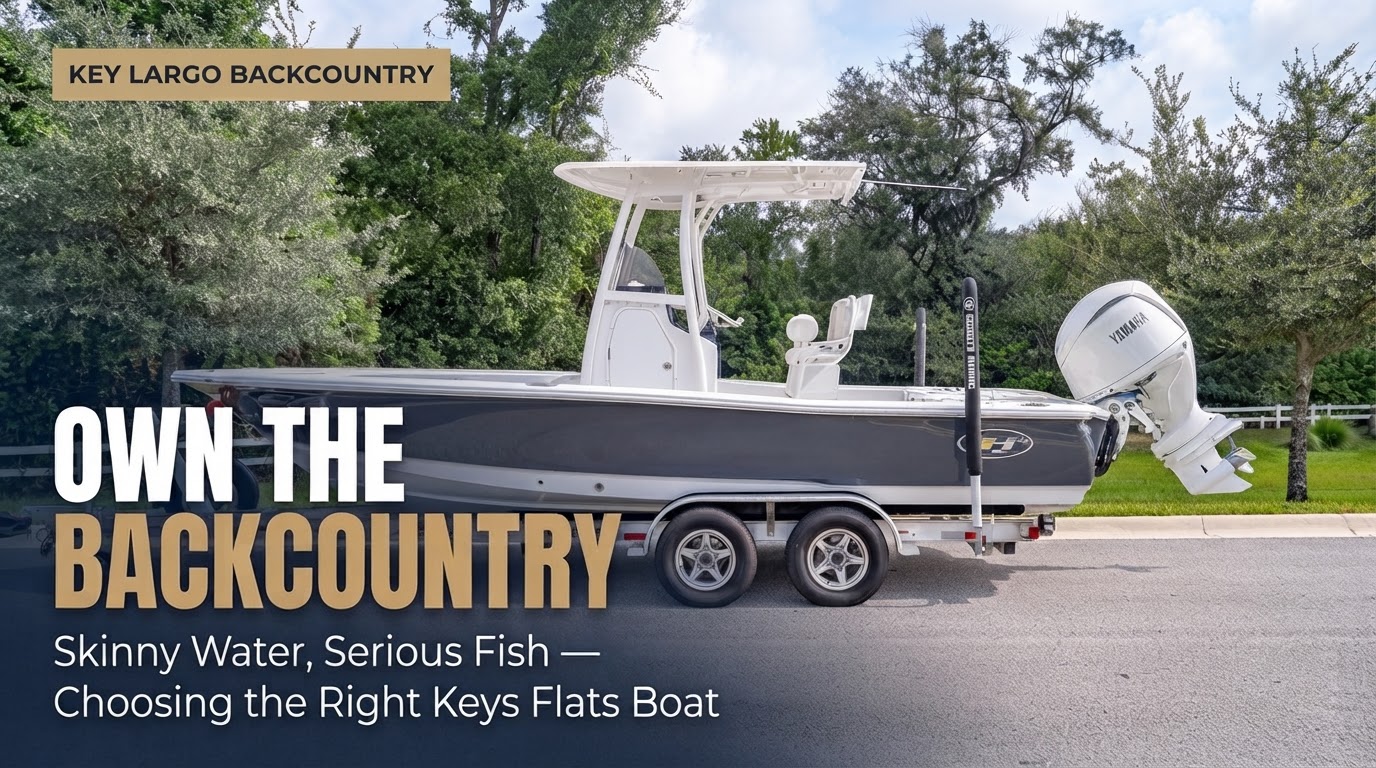
- The Sea Hunt BX Answer: The Sea Hunt BX 22 BR carries a minimum draft of 1’1″ with a 15-degree transom deadrise and a 2,700 lb dry weight, according to Sea Hunt showroom specifications published by Suffolk Marine Center — shallow enough for the flats, solid enough for a Blackwater Sound chop.
- Range Is the Second Question: The BX 22 BR carries 53 gallons of fuel per those same specifications, which shapes how far you roam from the MM 106 ramps before you turn around.
- One Boat, Two Missions: Most Upper Keys families need a hull that poles a bonefish flat in the morning and runs the Whale Harbor stretch with four people aboard in the afternoon. That is a bay boat, not a flats skiff and not an offshore center console.
- Where to Buy It: Ultimate Marine Key Largo at MM 106 is Florida’s #1 Sea Hunt Dealer, an award given by Sea Hunt Boats on unit sales volume and customer service.
It is a little after seven on a January morning and the tide is falling out of Florida Bay. You idle out past the last channel marker, kill the engine, and step up on the platform. Ahead of you is a grass flat with maybe eighteen inches over it and a tailing fish working the edge. The question that morning is not what fly to throw. It is whether your hull was already sitting on the bottom when you shut the motor off.
That single moment is what people are really asking about when they search for the best boat for the Florida Keys backcountry. The answer is not a brand slogan. It is a set of trade-offs between how skinny you can float, how much weather you can take on the ride home across Blackwater Sound, and how many people and how much gear you need to carry while doing both.
This article works through those trade-offs the way a buyer at MM 106 actually experiences them: first the hull characteristics that decide where you can fish, then the practical matching of boat to the way Upper Keys families really use the water between Key Largo, Tavernier and Islamorada.
What Makes a Boat Right for the Florida Keys Backcountry?
The Short Answer:
The Florida Keys backcountry is the shallow grass, basin and mangrove water on the Florida Bay side of the islands. The right boat there is a bay boat: shallow enough to float a flat on a falling tide, with enough deadrise and freeboard to cross Blackwater Sound when the wind picks up. The Sea Hunt BX series is built around exactly that compromise.
Draft Is the Number That Decides Your Season
Everything else on a backcountry boat is negotiable. Draft is not. A hull that needs an extra six inches of water is a hull that loses the last two hours of every outgoing tide, and in Florida Bay those are often the hours the fish are most predictable.
Sea Hunt showroom specifications published by Suffolk Marine Center list the BX 22 BR at a 1’1″ minimum draft. That is a working number for the flats between Key Largo and the outer basins, and it is achieved without giving up the running surface you need on the way home. If you want to understand how Sea Hunt gets there, the breakdown of Sea Hunt hull technology covers the design logic in detail.
Deadrise: The Trade-Off Nobody Should Hide From You
Here is the honest part. A flatter bottom floats shallower and poles more quietly. A sharper V cuts chop better and rides drier. You cannot maximise both in one hull, and any dealer who tells you otherwise is selling, not advising.
The BX 22 BR carries a 15-degree transom deadrise per those Suffolk Marine Center specifications. That is a deliberate middle position: shallow-water capable, and still enough angle to handle the short, steep chop that builds in Blackwater Sound when a north wind meets an outgoing tide. If your fishing is overwhelmingly offshore, a different hull serves you better, and the offshore hull capabilities guide is the more useful read.
Hull Characteristics That Matter in Florida Bay
- Minimum Draft: Determines how much of a falling tide you can fish and whether you can cut across a basin instead of running the long way around.
- Transom Deadrise: Governs ride quality in chop. Lower deadrise floats shallower; higher deadrise rides softer in a Blackwater Sound crossing.
- Dry Weight: A lighter hull floats higher and re-floats faster if you touch bottom. Sea Hunt lists the BX 22 BR at 2,700 lb dry.
- Fuel Capacity: Sets your realistic range from the ramp. The BX 22 BR carries 53 gallons per the same manufacturer showroom specifications.
- Freeboard and Layout: Decides whether the boat is comfortable for a family run to a sandbar as well as a solo poling session.
Range Thinking From the MM 106 Ramps
Fuel capacity is not an abstract spec in the Keys. It is the difference between a comfortable day and an anxious one. A 53-gallon tank, as Sea Hunt lists for the BX 22 BR, supports a full backcountry day out of Key Largo with reserve, provided you are honest about wind and how much time you spend running versus drifting.
Plan range around the worst case, not the average. A backcountry day that ends with a headwind ride home from the outer basins burns noticeably more than the same distance covered on a flat morning. Our notes on fuel burn and range planning walk through how to build that margin.
Real-World Field Scenarios
- Falling Tide on a Florida Bay Flat: You have a tailing bonefish forty yards off and ninety minutes of water left. A 1’1″ draft buys you most of that window. A deeper hull sends you looking for a channel while the fish is still feeding.
- Afternoon North Wind Across Blackwater Sound: The morning was glass. By two o’clock the sound is stacked with short chop and you have kids aboard. This is where deadrise earns its keep and where a pure flats skiff stops being fun.
- August Lobster Weekend Near John Pennekamp: Three divers, tanks, bags and a cooler. The boat has to carry weight, hold a shallow anchorage, and stay inside sanctuary rules on marker placement and speed.
- Running to Islamorada for Yellowtail: The same hull that poled a flat at dawn heads for structure off Islamorada in the afternoon. That crossover is the whole reason bay boats dominate the Upper Keys.
- Tarpon Under the Whale Harbor Bridge: Night tide, current ripping, close-quarters boat handling. Deck space and clean gunwales matter more than top speed.
Which Sea Hunt Fits Your Backcountry Fishing?
The Short Answer:
Sea Hunt builds three families that serve Upper Keys anglers differently. The BX bay boat series is the backcountry specialist for Florida Bay flats and basins. The Gamefish line leans toward mixed inshore and nearshore fishing. The Ultra series is the family-and-fishing crossover for owners who also run to reef and sandbar. Match the series to your most common day, not your rarest one.
Start With Your Most Frequent Day, Not Your Dream Day
The single most common buying mistake in the Keys is specifying a boat for the trip you take twice a year. Someone buys for a rare Gulf Stream mahi run and then spends fifty weekends wishing they could get across a flat.
Count your actual days. If most of them are Florida Bay, mangrove edges and backcountry basins, the BX bay boat series is where to start looking. If you split evenly between backcountry and reef, look at the Gamefish series layouts before you decide.
Series Comparison by Mission
- BX Bay Boat Series: Built for shallow water. Best when your default day is Florida Bay flats, basins and mangrove shorelines, with occasional runs to nearshore structure.
- Gamefish Series: A fishing-first center console that handles inshore work and steps out to nearshore reef comfortably. Best for anglers who want one serious fishing platform across both.
- Ultra Series: The family crossover. Best when the same boat has to do a Pennekamp snorkel morning, a sandbar afternoon and a yellowtail evening without complaint.
- Choosing Between Them: Draft favours BX, offshore comfort favours Ultra, and pure fishing layout favours Gamefish. Pick the one that fits the day you have most often.
Family Load Is a Real Design Input
Backcountry boats get bought by anglers and used by families. That is not a criticism, it is the reality of boat ownership in Key Largo and Tavernier. The boat that only works with one person aboard is the boat that sits on the trailer.
Look hard at seating and shade before you sign anything. Our overview of Sea Hunt seating configurations is worth reading with your family in the room, and the Gamefish versus BX comparison lays out the choice most Upper Keys buyers actually face.
Rigging Choices That Change Backcountry Performance
- Shallow-Water Anchor: A pole-style anchor holds you on a flat without the noise and swing of a traditional anchor set. This is the first accessory most backcountry owners add.
- Trolling Motor With Spot Lock: Lets you work a mangrove edge or hold position on a basin edge in wind without touching the bottom.
- Poling Platform: Raises your sightline for tailing fish in Florida Bay. Adds weight aft, so weigh it against how often you actually sight-fish.
- Jack Plate and Prop Selection: Changes effective operating depth and hole-shot in soft bottom. Discuss it with a rigger who knows Keys water, not a generic spec sheet.
- Livewell Plumbing: Pilchards and pinfish in August need real circulation. Undersized wells cost you bait before you reach the fish.
When a Bay Boat Is the Wrong Answer
Be clear about the limits. If you routinely run to the Gulf Stream for sailfish and mahi in questionable weather, a bay boat is not the right tool and no amount of rigging fixes that. Buy the offshore hull and accept that some flats stay off-limits.
Equally, if you fish nothing but ankle-deep water alone and never carry passengers, a dedicated skiff will out-fish a bay boat in that one narrow use. The bay boat wins on breadth, not on either extreme. If you are still weighing platforms, the model comparison tool is a good place to line them up side by side.
What to Check Before You Buy
- Sea Trial on Your Water: Run the boat in Blackwater Sound on a windy afternoon, not on a calm morning in a protected basin. You learn nothing from perfect conditions.
- Loaded Draft, Not Empty Draft: Published minimum draft assumes a light boat. Add fuel, ice, four adults and gear, then look again.
- Trailer and Ramp Fit: Confirm the rig handles the ramps you actually use in the Upper Keys, including tight turns and shallow launch approaches.
- Service Access Nearby: A boat serviced in the Keys is a boat that gets used. Confirm where warranty and routine work happens before purchase.
- Resale Reality: Bay boats hold interest in this market because they suit the water. A specialised hull narrows your future buyer pool.
When you are ready to talk numbers, our boat financing options and the trade-in valuation form handle the two questions buyers ask most often.
Key Takeaways
- Draft First: In the Florida Keys backcountry, minimum draft decides how much of the tide you can fish, and the Sea Hunt BX 22 BR is listed at 1’1″ by Sea Hunt showroom specifications.
- Deadrise Is a Trade-Off: The BX 22 BR’s 15-degree transom deadrise balances shallow-water access against ride quality when Blackwater Sound gets short and steep.
- Range Comes From Honest Planning: A 53-gallon tank supports a full Upper Keys day when you plan around a headwind return, not an average run.
- Buy for Your Common Day: Backcountry-first buyers should start with the BX series; mixed inshore-and-reef anglers should compare Gamefish and Ultra before deciding.
- Local Proof Matters: Ultimate Marine Key Largo at MM 106 is Florida’s #1 Sea Hunt Dealer, an award issued by Sea Hunt Boats on unit sales volume and customer service.
Frequently Asked Questions
What is the best boat for the Florida Keys backcountry?
A bay boat is the strongest general answer for the Upper Keys. It floats shallow enough to work Florida Bay flats and basins while still handling a windy crossing with family aboard. Among Sea Hunt models, the BX series is purpose-built for that mix.
How shallow does a Keys backcountry boat need to float?
Shallower is better, but usable is what counts. Sea Hunt showroom specifications published by Suffolk Marine Center list the BX 22 BR at a 1’1″ minimum draft, which covers most Florida Bay flats work. Remember that published minimums assume a lightly loaded boat.
Can one boat handle both the backcountry and the reef?
Yes, within limits. A bay boat crosses to nearshore structure off Islamorada and Key Largo comfortably in reasonable weather. Regular Gulf Stream runs for sailfish and mahi call for an offshore hull instead.
Do sanctuary rules affect where I can run in the backcountry?
They do. Parts of the Upper Keys carry zone restrictions, idle-speed areas and no-motor zones, and they change from place to place. Check current rules with the Florida Fish and Wildlife Conservation Commission and NOAA before you plan a route.
What should I add to a new backcountry boat first?
Most Upper Keys owners start with a shallow-water anchor and a trolling motor with position-holding. Both let you fish a flat or a mangrove edge quietly without disturbing the water you came to fish.
Where can I see these boats near Key Largo?
Ultimate Marine Key Largo sits at 106280 Overseas Hwy at MM 106. You can browse Sea Hunt boats for sale before you visit and arrange a sea trial on the water you actually fish.
Talk Backcountry Boats With Ultimate Marine Key Largo
Tell us how you actually fish — how many days on the Florida Bay flats, how many crossing to Islamorada, how many with the family aboard — and we will match a Sea Hunt to that pattern rather than to a spec sheet. We are at MM 106 on Overseas Highway, and we sea trial on the same water you will run.
Reach the Key Largo team through our Key Largo contact page or call (786) 386-2847 to set up a day on the water.
External References
- Florida Fish and Wildlife Conservation Commission: Florida fishing and boating regulations
- NOAA: marine weather and sanctuary information
- United States Coast Guard Boating Safety: recreational boating safety resources
- Florida Highway Safety and Motor Vehicles: vessel titling and registration
- Discover Boating: boat buying research